
Intallation with a hybrid inverter
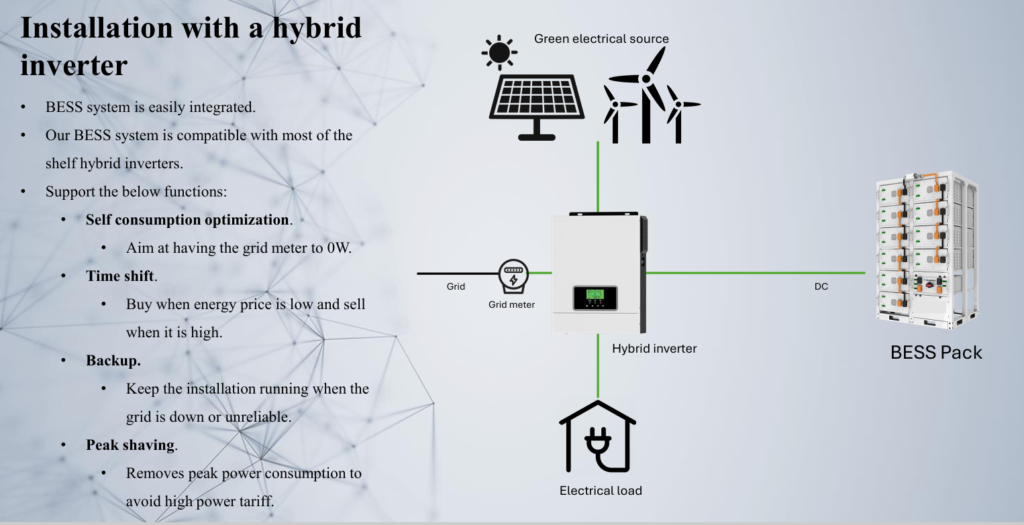
Key characteristic
- All in one single device (PV, Battery ad Grid)
- 🔁 Integrated DC ↔ AC conversion
- ⚡ Built-in basic control logic
- 🧩 Simple architecture
- 🏠 Common in residential / small commercial setups
Advantages
✅ Fast deployment
✅ Lower upfront cost (CAPEX)
✅ Plug & play
✅ Ideal for self-consumption + backup
Limitations
❌ Limited flexibility
❌ Not scalable for large systems
❌ Basic control only (not designed for advanced optimization)
Hard to implement:
- real energy arbitrage
- price/demand forecasting
- multi-variable optimization
❌ Strong vendor lock-in
When it makes sense
- Residential projects
- Small businesses
- Simple use cases (solar + battery + backup)
Intallation without a hybrid inverter
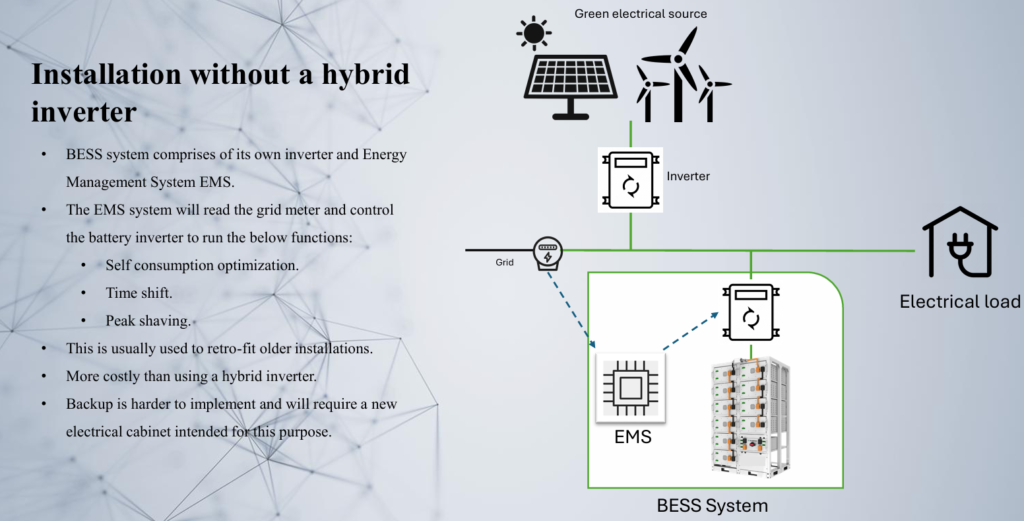
Key characteristics
- Modular architecture: Battery system, PCS, EMS, Grid–>Everything is decoupled and controlled by software
- Full control via EMS
- Highly scalable (kW → MW → GW)
- Designed for industrial environments
Advantages
✅ Maximum flexibility
✅ True optimization (where your value is)
Enables:
- dynamic energy arbitrage
- intelligent peak shaving
- consumption & price forecasting
- ROI-driven optimization
✅ Hardware-agnostic (no vendor lock-in)
✅ Integrates multiple assets:
- solar (PV)
- grid
- generators
- multiple battery systems
Limitations
❌ Higher complexity
❌ Higher initial CAPEX
❌ Requires real engineering (EPC)
❌ Needs a strong EMS to unlock value
When it makes sense
- Industrial clients
- Large energy consumers
- Projects with clear ROI targets
- Advanced energy strategies