
Description
Our concept for an Energy Management System (EMS) focuses on two core areas: the design of the battery pack, including the Battery Management System (BMS), and the EMS itself. We work with second-life batteries, giving them a sustainable second use while offering cost-effective energy storage solutions.
We adopt the OpenEMS approach, a modular platform for energy management applications. This framework enables monitoring, control, and integration of storage systems with renewable energy sources and complementary technologies such as EV charging stations, heat pumps, electrolysers, and time-of-use electricity tariffs.
Our main expertise lies in developing advanced algorithms and battery pack design. The algorithms incorporate real-time inputs such as battery health to decide whether energy should be stored or sold. They are also tailored to the specific energy price structures and levels of granularity in each country, ensuring both efficiency and economic optimization.
EMS Architectue
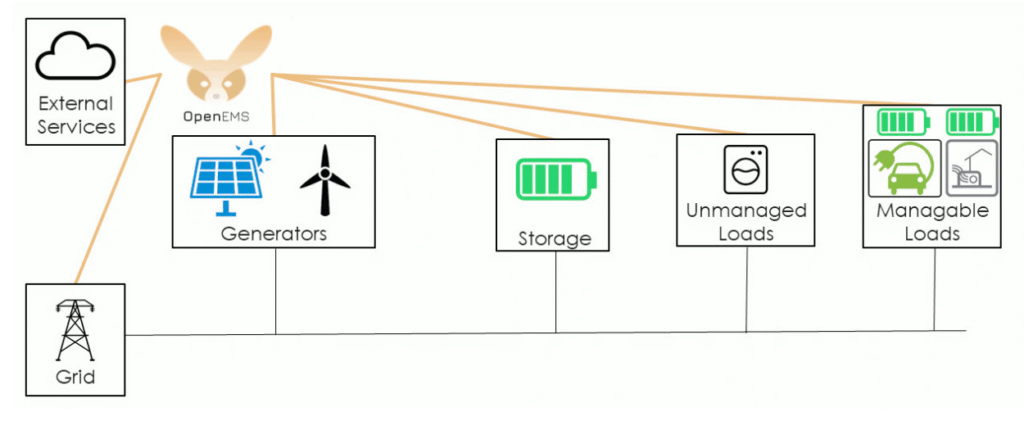
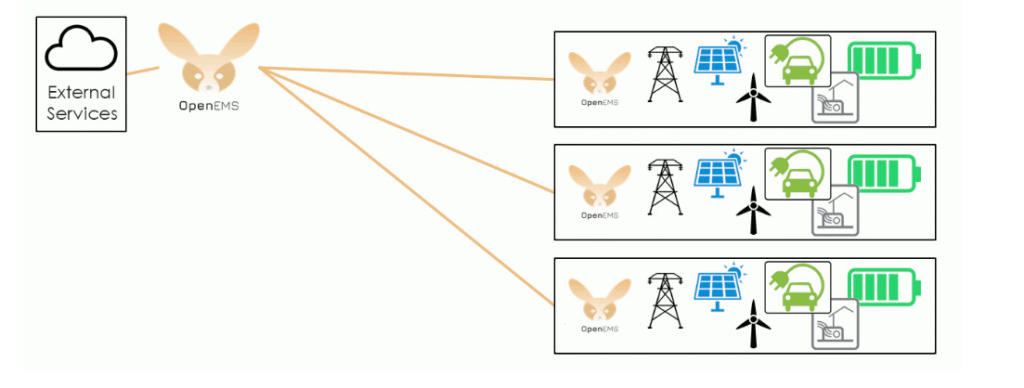
The EMS architecture is built on three powerful components: Edge, Backend, and UI. The EMS Edge operates locally, communicating directly with your devices, executing control algorithms, and ensuring fast, reliable decisions. The EMS Backend, hosted in the cloud, connects all decentralized systems, providing aggregation, analytics, and global coordination. Finally, the EMS UI delivers a seamless user experience across browsers and mobile devices, making system insights and control accessible anytime, anywhere.
EMS components:
- EMS Edge runs on site, communicates with devices and services, collects data and executes control algorithms.
- EMS UI is the real-time user interface for web browsers and smartphones.
- EMS Backend runs on a (cloud) server, connects the decentralized Edge systems and provides aggregation, monitoring and control via internet.
EMS Edge:
EMS Backend:
System Architectue:
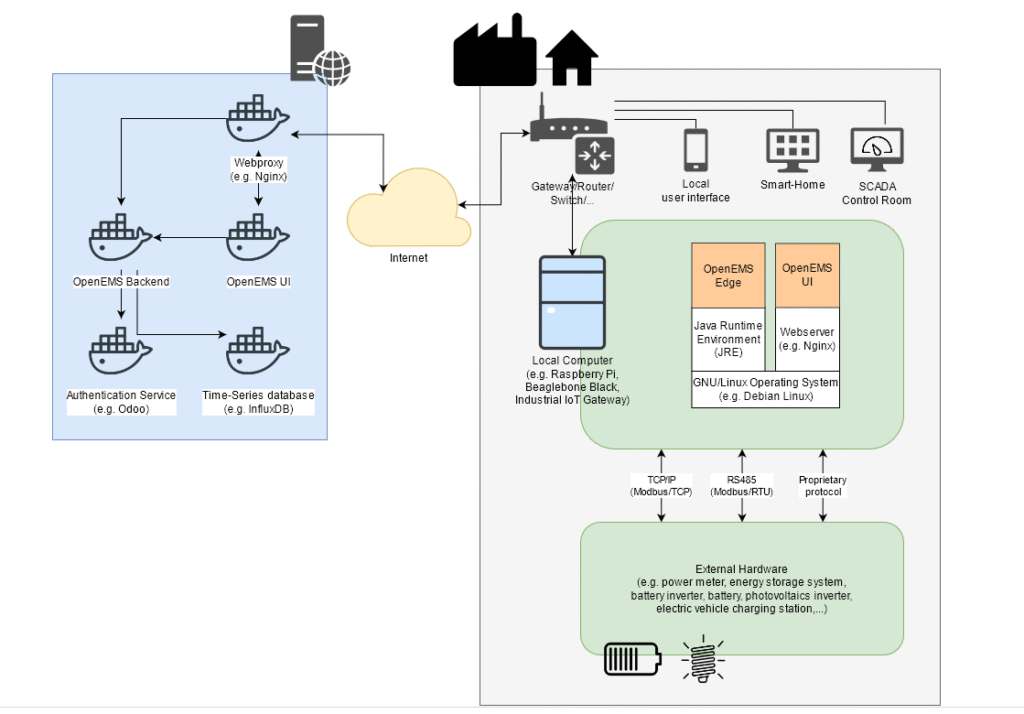
Energy systems are becoming more decentralized, dynamic, and data-driven. This EMS architecture is built to unlock the full potential of this new energy landscape. By combining local intelligence at the Edge with powerful cloud-based coordination in the Backend, and intuitive control through the UI, we provide the foundation for sustainable, cost-effective, and future-ready energy management.